Are Cruise Lines Becoming More Restrictive?

What Travelers Need to Know in 2026
If you’ve been following cruise news lately, you may have noticed a new pattern.
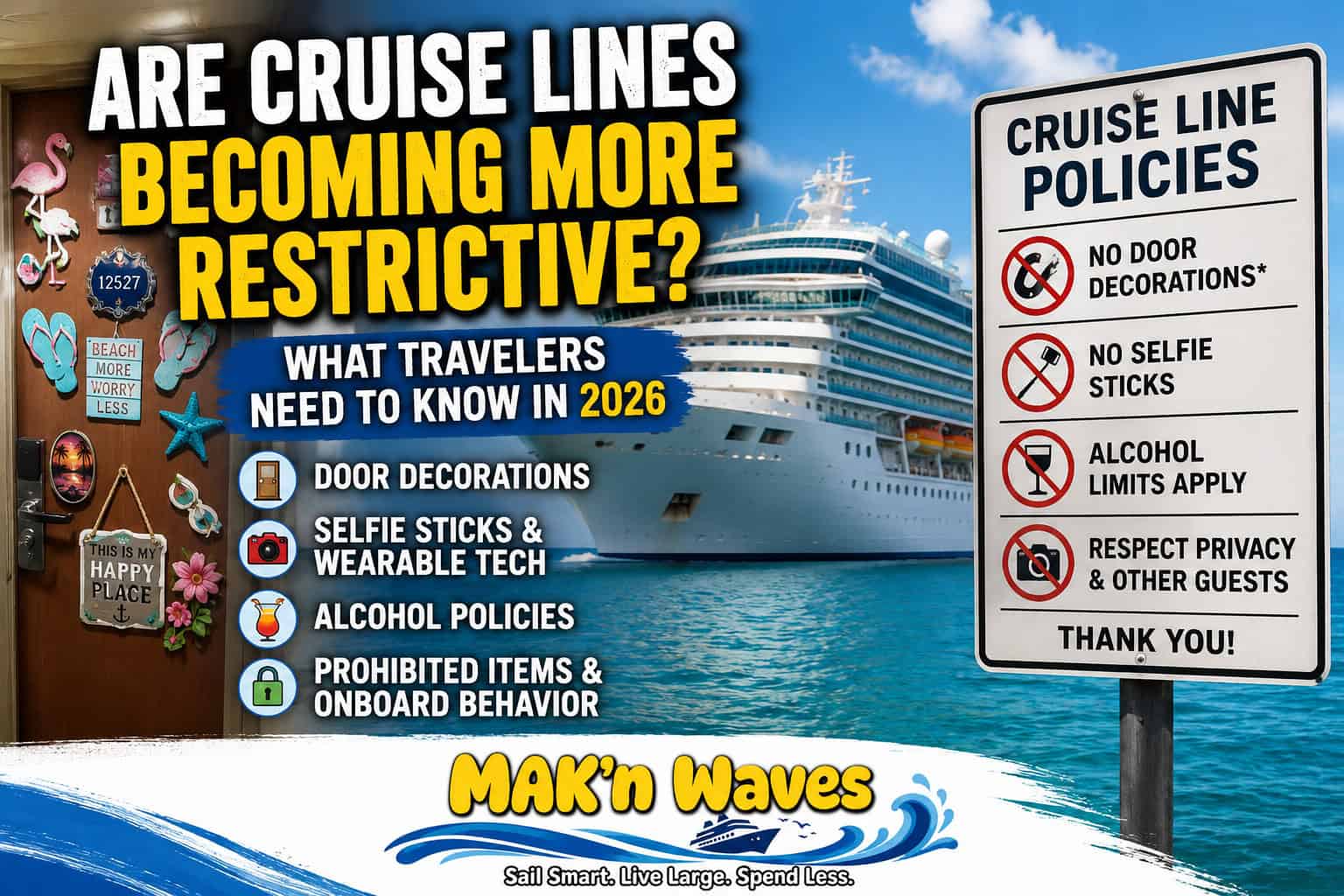
Royal Caribbean recently updated portions of its prohibited items policies. Disney Cruise Line has tightened certain alcohol allowances and cabin decoration guidelines. Royal Caribbean’s evolving stance on door decorations continues to spark debate among cruisers, while various cruise lines have implemented or clarified policies surrounding selfie sticks, wearable technology, photography, and onboard behavior.
Individually, none of these changes seem particularly dramatic but together, they raise an interesting question:
Are cruise lines becoming more restrictive?
If you spend any time in cruise Facebook groups, the answer would appear to be a resounding “yes.” Every policy change seems to generate hundreds of comments from passengers who are convinced cruise lines are slowly squeezing the fun out of cruising.
But after looking at the trend more closely, I’m not convinced that’s what’s actually happening. In fact, I think something else may be going on entirely.
The More Popular Cruising Becomes, The More Rules Become Necessary
Cruising today is very different than it was twenty years ago. Ships are larger, passenger counts are higher, social media is everywhere, technology has become part of everyday travel, and perhaps most importantly, cruising has become one of the most mainstream vacation choices in the world.
When you put 5,000 or more guests on a ship, many of whom may be first-time cruisers, cruise lines can no longer rely on passengers understanding unwritten expectations. Those expectations eventually become written policies.
What many travelers see as “new restrictions” may actually be cruise lines documenting rules that previously didn’t need to be explained.
The Cruise Door Decoration Debate
A perfect example is the ongoing discussion surrounding cabin door decorations.
We recently explored this topic in our article, The Cruise Door Decoration Debate Is Getting Heated, and judging by the reader response, people have strong opinions on the subject.
For many cruisers, decorating a cabin door is part of the vacation experience. Families celebrate birthdays, anniversaries, reunions, graduations, and milestone cruises with magnets, signs, and personalized decorations. Some displays are incredibly creative.
Cruise lines, however, see another side of the equation. Hallway safety, fire regulations, maintenance concerns, and emergency access all become considerations when thousands of cabin doors are involved. As a result, several cruise lines have clarified what types of decorations are permitted, how they can be attached, and what materials may be prohibited.
To some travelers, it feels like a harmless tradition is being restricted but to cruise lines, it often looks like a safety policy that finally needed to be put in writing.
Disney’s Policy Changes Aren’t Random
Disney Cruise Line has also made headlines recently by tightening certain alcohol and decoration policies. At first glance, these changes can feel unnecessary. After all, most guests aren’t causing problems.
But Disney’s challenge is unique. Their ships attract large numbers of families, first-time cruisers, multi-generational groups, and special-event travelers. Consistency becomes incredibly important when managing thousands of guests with different expectations.
Most passengers will never notice these policy changes, but for cruise lines, establishing clear guidelines often prevents confusion, reduces disputes, and makes enforcement easier for crew members. That’s not nearly as exciting as a social media debate, but it may explain why these changes continue to occur.
Selfie Sticks, Smart Glasses, and The Privacy Question
Some of the newest discussions in cruising have little to do with decorations or alcohol and much more to do with technology.
Today’s ships are filled with smartphones, livestreams, action cameras, and wearable devices capable of recording video almost anywhere.
Twenty years ago, privacy concerns were relatively simple. Today, a guest relaxing by the pool may unknowingly appear in a livestream, YouTube video, TikTok clip, or social media post viewed by thousands of people.
As wearable technology becomes more common, cruise lines are being forced to address situations that simply didn’t exist when many of their original policies were written. Personally, I had my first run-in with Smart Glasses last week while at a conference, where I happen to catch myself on a video feed displayed on the jumbotron (ok, so it was just a large screen at a conference center, but might as well have been a jumbotron.) The stream was from Smart Glasses worn by the host who was walking around the room demonstrating this technological marvel. Cool tech – yes, but actually thought it was quite invasive.
Whether you agree with the restrictions or not, these policies are often designed to balance one guest’s desire to document their vacation with another guest’s desire to enjoy theirs privately.
Why Prohibited Items Lists Keep Growing
Royal Caribbean’s recent updates to prohibited items policies generated plenty of discussion as well.
Whenever cruise lines add new items to these lists, passengers often assume the changes are driven by revenue concerns or unnecessary bureaucracy. I believe that in all reality, it’s usually far less exciting.
Many prohibited items involve fire safety, electrical safety, battery technology, or operational concerns. As new products enter the marketplace, cruise lines must decide whether those items can safely coexist within a floating city carrying thousands of passengers.
Cruise ships operate in a unique environment. Something that seems perfectly safe in a hotel room as example, may present entirely different risks at sea.
Is This a Family Cruise Line Trend?
One thing I found particularly interesting while researching this topic is that many of the recent policy discussions seem to involve cruise lines such as Royal Caribbean, Disney, and occasionally Carnival. That made me wonder:
Is this really an industry-wide trend, or is it primarily occurring among family-focused cruise lines? I figured there had to be something to that theory.
These brands attract enormous passenger volumes, large family groups, and significant numbers of first-time cruisers. The more diverse the guest population becomes, the harder it is to rely on unwritten expectations. Written policies become necessary.
That doesn’t mean families are causing problems, but it simply means cruise lines serving the broadest audiences often need the clearest rules.
What About Celebrity, Princess, and Holland America?
Interestingly, we don’t seem to hear nearly as many public discussions about new policies from cruise lines like Celebrity, Princess, or Holland America. Even after doing specific searches, it was hard to find anything with these lines that compares to the changes we are seeing with Royal, Disney and Carnival.
That doesn’t mean these cruise lines don’t have rules, as they absolutely do. These cruise lines do tend to attract more experienced cruisers, older demographics, and a higher percentage of repeat guests. Many passengers already understand cruise etiquette, onboard expectations, and common-sense boundaries. As a result, fewer situations require highly visible policy changes.
The rules still exist but they just don’t generate as many headlines.
Even Carnival Has Been Tightening Expectations
Carnival has long carried a reputation as the industry’s “fun ship,” and sometimes unfairly gets labeled as the party cruise line. Yet Carnival has also been among the most visible cruise lines when it comes to strengthening passenger conduct policies and increasing enforcement of onboard behavior expectations.
Why? Because like with most things in life, cruise lines have learned that a very small number of disruptive passengers can negatively impact the vacation experience for thousands of others. The whole “one bad apple” saying is pretty universal.
Final Thoughts
Maybe cruise lines aren’t becoming more restrictive at all and maybe they’re simply documenting rules that used to go unsaid.
Twenty years ago, cruising was a smaller industry filled largely with experienced repeat guests. Today, ships are larger, passenger demographics are broader, technology is everywhere, and cruising has become one of the most popular vacations in the world. In that environment, cruise lines can no longer rely on unwritten expectations.
The more popular cruising becomes, the more those expectations eventually find their way into writing.
Of course, if cruise lines continue updating policies, there will never be a shortage of opinions about them. And if you find yourself venting about one of these changes during your next sailing, you might want to revisit our recent article, What Kind of Cruise Complainer Are You? You may discover you’re not alone.
Whether you agree with every new rule or not, understanding the reasoning behind them often reveals something important: most cruise lines aren’t trying to make vacations less enjoyable. They’re trying to preserve the experience for the thousands of passengers who share the ship with us.
One Final Thought
Susan will probably tell you that I’m naturally wired to look for the reasoning behind things. Sometimes that’s helpful and sometimes it just means I overthink everything.
So if this article came across as me defending every cruise line policy under the sun, that’s not my intention. This isn’t intended to be a kiss-up-to-the-cruise-lines article.
Trust me, I don’t wake up each morning wondering how I can help Royal Caribbean confiscate extension cords or how Disney can further regulate cabin door decorations. I’m simply fascinated by why these rules keep appearing.
And if understanding the reasoning behind them helps prevent me from spending the next few months watching viral videos of cruisers losing their minds over magnet placement regulations, alcohol allowances, and the future of playing hide-and-seek with decorative rubber ducks, then I consider this article a public service.
You’re welcome.