Live from Coral Princess: The Earthquake Was Scary. The Silence Was Harder.

Dispatches from Coral Princess – Panama Canal Cruise
Most of us board a cruise believing we’ve planned for just about everything. We research the itinerary, compare cabins, purchase travel insurance, pack medications, and spend months looking forward to finally stepping aboard. We know that weather can change and ports occasionally get canceled, but we also assume that if something truly unexpected happens, someone has a plan.
As I write this, Susan and I are still aboard the Coral Princess, less than 48 hours after experiencing a 7.7 magnitude earthquake while docked in Panama City. This week’s MAK’n Waves article was supposed to be about the outstanding shore excursion we had just completed that morning, but instead, I’m writing about one of the most unforgettable travel experiences of my life.
Before I go any further, let me also say the most important thing. Everyone aboard Coral Princess is safe., and that’s really how the story ends.
But getting there taught me a few things about leadership, communication, and human nature that I wasn’t expecting to learn on a Panama Canal cruise.
It Started Like Any Other Cruise Day
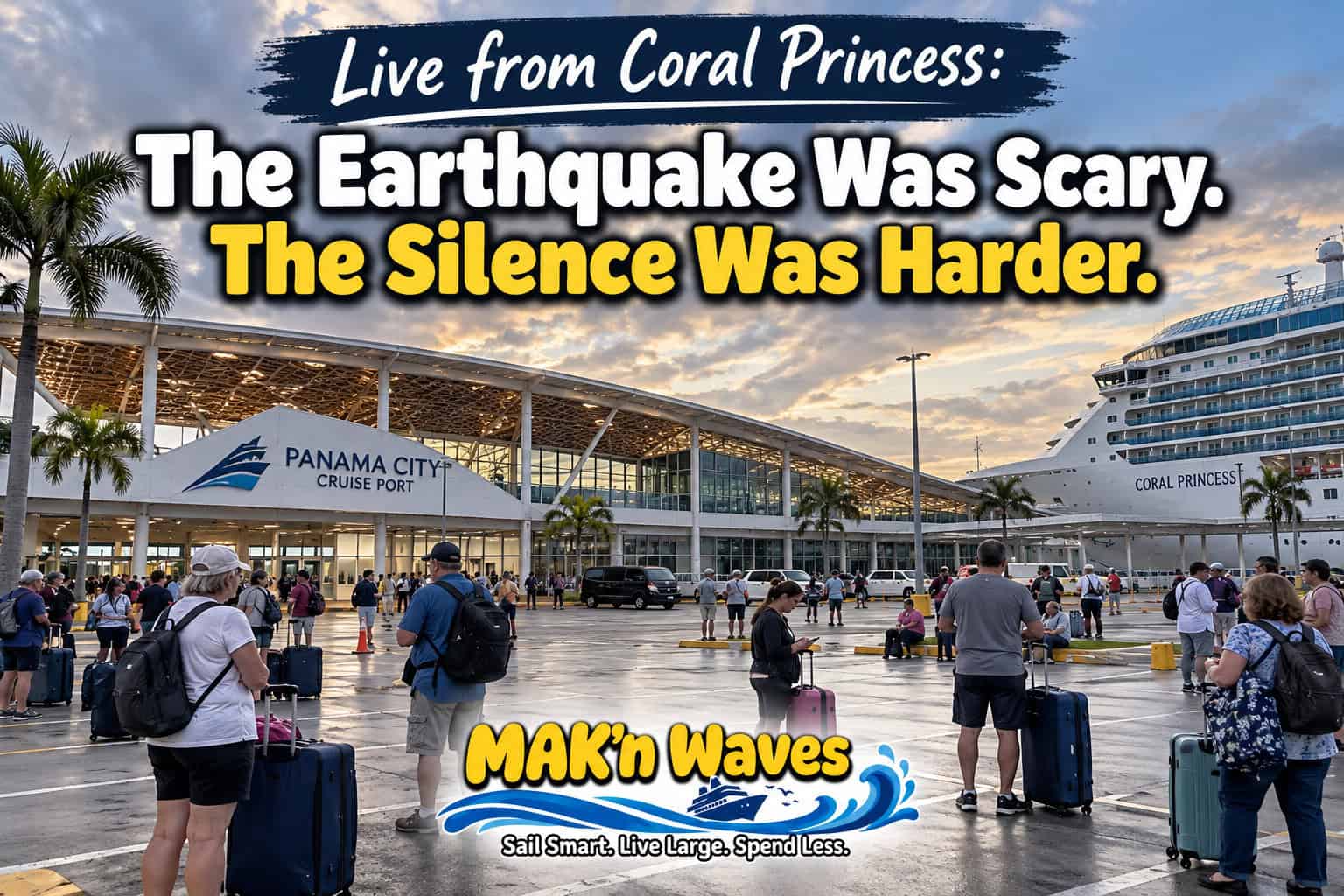
Friday morning couldn’t have been better. Susan and I had just returned from a wonderful shore excursion, one I’ll definitely be writing about soon, and were walking through the Panama City cruise terminal to pick up the highly desired and ever illusive Panama Canal magnet. The terminal is a beautiful, modern structure dominated by glass and exposed steel framing, giving it a bright and open feeling.
Then the windows started rattling. It sounded almost like a powerful gust of wind or perhaps a large aircraft flying overhead. Within seconds, however, the shaking intensified, the glass vibrated harder, the walls visibly flexed, and pieces of ceiling framing began falling.
Growing up in California, earthquake drills were simply part of life. My first major earthquake was the ’72 Sylmar earthquake, and although it’s been decades, that experience immediately came rushing back. I recognized what was happening almost immediately.
Many around us did not. Gift shop employees abandoned their booths and everyone rushed towards the stairs toward the exits. Within moments, calm had turned into chaos.
While Susan and I get swept into the current, I instinctively pulled Susan back beneath a doorway and away from the large glass windows. Several others joined us there as the building continued shaking.
The earthquake itself probably lasted no more than fifteen or twenty seconds. Like anyone who has lived through a significant earthquake though, I can tell you it felt much longer.
As I reflected later that afternoon, I realized something else. My California upbringing didn’t make me any less concerned but it simply gave me a frame of reference. Experience doesn’t remove fear, but it often changes how we respond to it. While others were still trying to understand what was happening, I had already shifted to thinking about where the safest place might be.
When Uncertainty Takes Over
Once the shaking stopped, alarms immediately sounded throughout the terminal and everyone was instructed to evacuate. Once outside, most of us just congregated in a nearby parking lot away from the building.
Standing there, I noticed something the television cameras rarely capture. Fear has a face.
Many of the young women working inside the terminal who bolted out of the building without hesitation, were visibly shaken. One appeared to be suffering a panic attack and became physically ill. Around us, passengers began asking the same questions.
“What just happened?”
“Are there aftershocks?”
“Can we get back on the ship?”
“What happens now?”
The honest answer was…Nobody seemed to know.
For roughly fifteen minutes, we simply waited, as everyone tried to get their nerves back under control. Eventually, a Princess representative appeared and instructed us to board several waiting motor coaches that had just returned from shore excursions. On the surface, it made perfect sense. Get everyone out of the Panama heat and into air conditioning while the situation was assessed.
Unfortunately, that isn’t quite how it unfolded.
Passengers continued boarding until there were no seats left. People stood in the aisles. Our driver never turned on the air conditioning, and more importantly, neither the driver nor anyone else seemed able to tell us what we were doing or what the plan was.
Looking back, I don’t think people were anxious because they were sitting on a bus. They were anxious because they had no idea why they were sitting on a bus.
As we waited, phones began buzzing with breaking news alerts. Early reports estimated the earthquake at magnitude 8.0. Warnings of aftershocks started appearing online and a Tsunami warning was announced.
Everyone had a different story about where they had been when the quake struck, but one thing was common throughout the bus, uncertainty. And when people don’t have information, they naturally begin filling in the blanks themselves.
Looking back, I keep thinking how differently those next thirty minutes sitting on the overcrowded bus could have felt. Imagine if a Princess crew member had stepped aboard for just one minute and said:
“Folks, here’s what we know. The terminal has been evacuated. Our priority right now is getting everyone safely back to Coral Princess. We don’t yet know when we’ll sail or what local authorities may decide, but we’ll continue updating you as we learn more.”
That’s it. It wouldn’t have answered every question, it wouldn’t have stopped the aftershocks, but it would have answered the one question everyone was silently asking: Is someone in charge?
Panic Is Contagious. So Is Leadership.
Eventually, our bus doors closed and we finally began moving toward Coral Princess.
Then, just short of the ship, the bus stopped. Moments later, a powerful aftershock struck, later reported as magnitude 6.6.
One passenger immediately stood up and insisted, “Everybody get off the bus! Everybody get off the bus!”
Within seconds, nearly half the passengers were moving toward the doors.
Susan and I stood up, but we stayed where we were. Our thought was simple: we were away from the building, inside a large vehicle with nothing overhead that could collapse. It actually seemed like one of the safer places to be.
When the aftershock ended, those of us still on the bus simply looked at one another, reaffirming we were all in the safest place to be at that moment. No one said it aloud, but I think we were all wondering the same thing. “Why did everyone get off?”
I’ve read about herd mentality before and have occasionally seen glimpses of it at larger sporting events, though Friday afternoon was the first time I’d ever watched it unfold right in front of me so vividly.
It was fascinating, and honestly a little unsettling, to watch dozens of intelligent adults instantly follow one confident voice without knowing whether that advice was actually correct.
The more I think about it, the more I realize panic isn’t really contagious. Uncertainty is.
And uncertainty almost always looks for someone to follow. Sometimes that person is right and sometimes they aren’t. That’s why visible leadership matters so much during moments like these.
The Silence Was Harder
Eventually our bus joined a line of others transporting passengers directly to Coral Princess because the cruise terminal had been closed. Nearly two hours had passed since the earthquake.
Once aboard, we learned that passengers who had remained on the ship during the earthquake had not been allowed ashore. All afternoon shore excursions had been cancelled. Looking at those decisions now, I actually agree with every one of them. In fact, I probably would have made the very same choices.
Around 4:00 that afternoon, after having settled back into our cabin, Susan and I decided to attend the daily trivia game, “Let’s Quiz Again,” looking forward to the normality of it. During the event, the host casually mentioned that the captain hoped to get everyone back onboard so the ship could leave port as quickly as possible.
I remember turning to Susan and saying, “Why are we hearing our emergency plan from the entertainment staff?”
That was the moment everything changed for me. I suddenly realized Princess probably did have a plan, but that the passengers simply weren’t hearing it.
About thirty minutes later, the captain addressed the ship for the first time. He acknowledged the earthquake and informed us there were still passengers ashore, but he didn’t explain the overall strategy. It wasn’t until nearly 8:00 that evening, almost seven hours after the earthquake, that the captain returned to announce everyone had safely boarded, we would depart immediately, anchor offshore overnight with other vessels, and resume our Panama Canal transit the following morning.
Ironically, I agreed with every one of those decisions.
What disappointed me wasn’t the plan, but it was how long it took for passengers to understand there was a plan.
I’ve sailed with Princess before and have recommended Princess to friends and clients. That’s precisely why writing this isn’t easy.
Final Thoughts
I don’t fault Princess for causing an earthquake, nor do I expect any cruise line to have a perfectly rehearsed earthquake response waiting on a shelf. Behind the scenes, I’m sure there were countless conversations taking place with local authorities, port officials, the Panama Canal Authority, and Princess headquarters. Those conversations take time.
Passengers don’t expect perfection or instant answers, but what we hope for is visible leadership and honest communication, even if that communication is simply, “Here’s what we know”, “Here’s what we don’t know yet”, or “Here’s what we’re doing next.”
That kind of communication changes everything.
It calms fears, reduces rumors, and reassures people that someone is leading.
As I finish writing this article, we completed our full transit of the Panama Canal. Long after this trip however, I suspect what I’ll remember most about Friday won’t be the earthquake itself, but will be the reminder that in moments of uncertainty, information is reassuring, leadership is calming, and silence often becomes the loudest thing in the room.
Update: This article was written aboard Coral Princess less than 48 hours after the earthquake while the events were still fresh in our minds. If Princess Cruises later shares additional details about their response or decision-making timeline, I’ll gladly update this article to reflect that information.