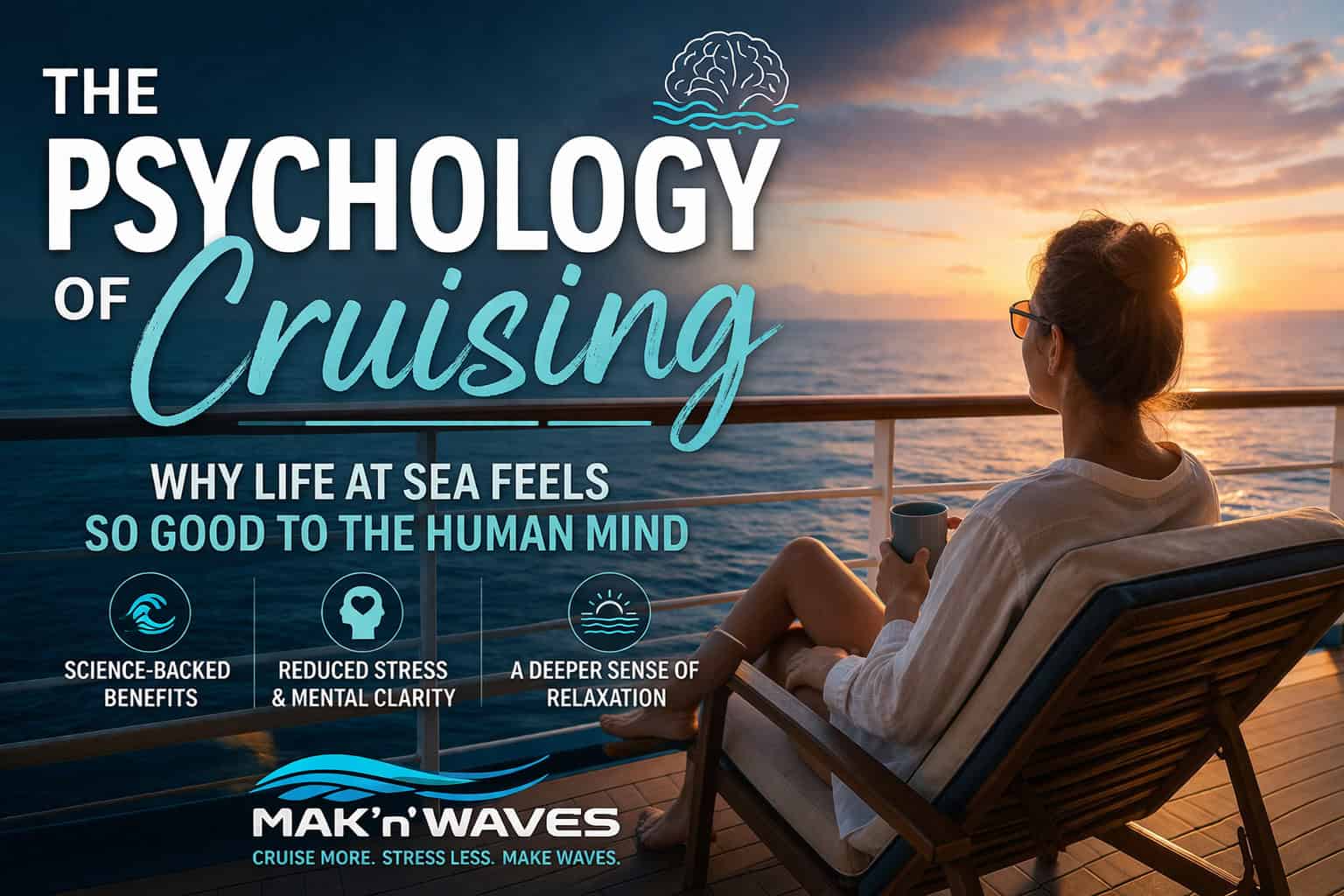
The Psychology of Cruising

Why Life at Sea Feels So Good to the Human Mind
There’s something about cruising that goes beyond the destinations, the food, or even the ships themselves.
Ask almost anyone who has taken a cruise, and you’ll hear a similar description: “I just felt… different. More relaxed, more present, and less rushed.
Over time, I’ve come to believe that cruising isn’t just a style of travel but an experience that taps into something deeper in how our minds respond to environment, rhythm, and simplicity.
In fact, much of what we feel on a cruise can be explained through what we call the psychology of cruising — the combination of environmental, behavioral, and neurological factors that make life at sea uniquely calming.
The Ocean Has a Measurable Calming Effect
Let’s start with the most obvious element: the ocean itself.
Researchers have long studied what’s sometimes referred to as “blue space” — environments dominated by water, such as oceans, lakes, and rivers.
A growing body of research, including studies published in journals like Health & Place, has shown that exposure to blue space is associated with:
- reduced stress and anxiety
- improved mood
- increased feelings of well-being
One widely cited European study found that people living closer to coastal environments reported significantly better mental health compared to those farther inland. This aligns with findings from the BlueHealth project, an EU-funded research initiative focused on how “blue spaces” — oceans, lakes, and waterways — can reduce stress and improve overall well-being.
The sound of waves, the movement of water, and the vast openness of the horizon all contribute to what psychologists describe as a mild meditative state.
This helps explain why simply sitting on a balcony and watching the ocean can feel so powerful. It’s not just relaxing — it’s neurologically calming.
Rhythmic Motion Helps Quiet the Mind
Another unique aspect of cruising is the gentle, repetitive motion of the ship.
Research in sleep science has shown that rocking motion can help people fall asleep faster and achieve deeper sleep cycles. A study published in Current Biology found that gentle motion can synchronize brain waves associated with sleep and relaxation.
While a cruise ship isn’t a cradle, the same principle applies.
That subtle, constant movement can help:
- reduce mental agitation
- promote relaxation
- improve sleep quality
It’s one of the reasons many people report sleeping better on a cruise than they do at home.
Fewer Decisions = Less Mental Fatigue
One of the most overlooked aspects of the psychology of cruising is how it reduces something called decision fatigue.
Psychologists like Roy F. Baumeister have studied how the human brain has a limited capacity for decision-making throughout the day. As decisions accumulate, mental energy declines, leading to stress, fatigue, and reduced self-control.
In everyday life, we are constantly making decisions, from what to eat, where to go, and what to do next.
Cruising removes many of those choices. Your accommodations, meals, transportation, and entertainment are already in place.
This is something we explore more deeply in Why Cruises Are Perfect for People Who Hate Planning Vacations.
When those decisions disappear, the brain finally gets a chance to rest.
The Power of Structured Freedom
Cruising offers something that is surprisingly rare in travel: structured freedom.
There is always something happening on a cruise ship, from activities to dining and entertainment — but none of it is mandatory.
This balance aligns with what psychologists call autonomy, a core component of motivation theory outlined in Self-Determination Theory research.
People feel most relaxed and satisfied when they have:
- options
- control over their choices
- freedom from obligation
Cruising delivers all three.
This adaptability is a key part of why cruising works for such a wide range of people.
For example:
- Overthinkers benefit from reduced variables — explored in Why Cruising is the Perfect Vacation for Overthinkers
- Introverts thrive with optional social interaction — see Why Cruises Are Perfect for Introverts
- Travelers with busy minds often find calm at sea — as discussed in Why Cruises Quiet an Anxious Mind
Sea Days and Cognitive Restoration
One of the most fascinating aspects of cruising is the effect of sea days.
Psychologists studying attention and focus describe something called Attention Restoration Theory (ART) — the idea that natural environments help restore cognitive function.
According to this theory, environments that are:
- calm
- immersive
- free from constant demands
allow the brain to recover from mental fatigue. This concept is widely discussed in psychology, including by the American Psychological Association, in this article entitled Nurtured by Nature, which highlights how time in natural settings can help restore focus and reduce mental strain.
Sea days check all of those boxes.
We explored this concept more deeply in The Psychology of At Sea Days.
Distance from Daily Life Matters More Than You Think
Another powerful factor in the psychology of cruising is simple but important: you are physically removed from your normal environment.
Research in behavioral psychology shows that context plays a major role in habit formation and stress patterns.
When you remove yourself from:
- your workspace
- your daily routines
- constant notifications
your brain has fewer triggers pulling you back into stress cycles.
At sea, that distance becomes literal and that allows people to:
- disconnect more fully
- relax more deeply
- become more present
A Vacation That Aligns with Human Nature
When you combine all of these elements — ocean environments, rhythmic motion, reduced decisions, structured freedom, and distance from daily stress — cruising begins to look less like a typical vacation and more like an experience that aligns naturally with how the human brain prefers to operate.
It’s not just about luxury or convenience, but about creating conditions where the mind can slow down, reset, and recharge.
Final Thoughts
The more I’ve reflected on it, the more I’ve come to see cruising differently. It’s not just a way to visit multiple destinations, but more so just a relaxing getaway.
It’s an environment that, almost by design, supports mental well-being. That’s the essence of the psychology of cruising.
And it’s also why so many people step off a cruise ship feeling calmer, clearer, and more refreshed than when they boarded.
Part of the MAK’n Waves “Cruising & The Mind” Series
This article serves as the foundation for our MAK’n Waves series exploring the psychology of cruising and why certain personalities thrive on cruise vacations.
You might also enjoy:
- Why Cruises Quiet an Anxious Mind
- Why Cruising is the Perfect Vacation for Overthinkers
- The Psychology of At Sea Days
- Why Cruises Are Perfect for People Who Hate Planning Vacations
- Why Cruises Are Perfect for Introverts
- Why Cruises Are the Ultimate Vacation for Curious Travelers
- Why Cruises Work for couples Who Travel Differently